Archive 2011
The Rabbinical Assembly reacts with horror at the increasing and wanton violence carried out by extremist Israeli Jews last week. Their attacks on the IDF last Tuesday at an army base in the West Bank, and the torching of a mosque in Jerusalem on Wednesday are only recent examples of this brazen behavior.
Our 2010 Resolution on Civil Discourse quotes Rabbi Israel Salanter in saying, “Be vigilant in protecting the honor of all people, especially those with whom you disagree.“ In resorting to violence, these extremists have greatly dishonored those with whom they disagree.
We affirm Prime Minister Netanyahu’s accepting the recommendations of a special task force on Jewish extremists' violence composed of top security officials calling for trying the rioters in military courts; giving the Israeli army the authority to detain demonstrators; and increasing the number of investigation teams and resources to conduct investigations.
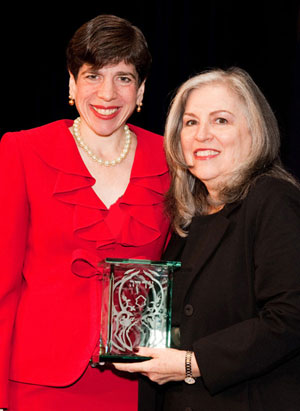
Pictured below:
Julie Schonfeld and Susan Turnbull, JWI Board of Trustees Chair (Photo: Michael Kress)
Washington, DC – Jewish Women International (JWI) honored Rabbi Julie Schonfeld yesterday with its 2011 Women to Watch award. Rabbi Schonfeld is the executive vice president of the Rabbinical Assembly (RA), the international association of Conservative/Masorti rabbis. She received the award for her commitment to the future of the Jewish people, her voice in the public square advocating the work of social justice as a fundamental Jewish obligation, and her approach to reimagining the work of denominations as visionary religious movements.
The Rabbinical Assembly expresses its gratitude and support to the government of Israel in its tireless efforts to bring about the release of Sergeant Gilad Shalit. After over five long, tortuous years in captivity, during which Hamas has flagrantly violated international human rights norms regarding Gilad Shalit’s visitation rights, we are extremely thankful that he has been returned to Israel and reunited with his family.
The following statement was endorsed by the Leadership Council of Conservative Judaism (LCCJ). It is the first step in an initiative by the RA to address concerns regarding challenges of diversity in rabbinic workplaces. It was written by a committee of the LCCJ led by Elliot Schoenberg of the RA, Danny Nevins of the JTS Rabbinical School, and Michael Miller of FJMC. The statement is a working document, and we welcome feedback and comments
The misleading statement by Agudath Israel concerning Magen Tzedek is a misrepresentation of a very important development in kosher food production in America. Magen Tzedek is based on our assertion that biblical and rabbinic law mandate fair treatment of workers (בל תלין), humane treatment of animals (צער בעלי חיים) and care of the earth (בל תשחית and שמירת הארץ) which can be translated into measurable standards applicable to commercial food production. These standards were developed in collaboration with SAAS, an organization acknowledged worldwide for its expertise in ethical certification programs.
We are appalled that Agudath Israel sees in ethical certification for kosher food an effort that “corrupts halakhah.” All Jews recognize that Judaism is a religion built upon ethical precepts. A central purpose of Jewish observance is to make us more decent and moral people, more capable of carrying out God’s vision of a just world.
We flatly reject Agudath Israel’s false accusations that we “harbor no respect for the very concept of halakhah.” We have always maintained that the Magen Tzedek would only be awarded to products already bearing kosher certification. Yet, we maintain that mitzvot bein adam l'makom (commandments between humanity and God) do not take precedence over mitzvot bein adam l'havero (commandments between one person and another).
Maimonides said that in fulfillment of Jewish life “one must be strict in their behavior and still go beyond the letter of the law (לפנים משורת הדין)." We see our role as ensuring that such is the case in the production of kosher food. Just as we would never delegate to the government to determine what constitutes proper kashrut certification, neither should we leave to the government enforcement of Jewish norms regarding ethical behavior. Instead of dismissing the work of one another, we call on all Jews to work together to ensure that our actions are truly a kiddush hashem--a sanctification of God's name.
Magen Tzedek affirms the eternal wisdom of Torah by bringing the moral values of Jewish religious tradition to bear on the daily operations of industrial food production, bringing more Jews to value the beauty of kashrut and Jewish observance assuring that we feel truly fulfilled when we sit down around our tables for a meal.
Contact: Rabbi Morris Allen, (651) 452-2226, mojo210al@aol.com
Rabbi Michael Siegel, (773) 868-5110, msiegel@ansheemet.org
It has come to our attention that Rabbinical Assembly materials have been misused by the Party for Animals in their debate in The Netherlands regarding legislation seeking to ban schechitah. The paper in question, “A Stunning Matter” by Rabbi Mayer Rabinowitz was written in 2001 and is intended to be a resource for individual rabbis making determinations for their communities. It does not reflect the public policy of the Rabbinical Assembly and it is a mistake to cite it this way in political discourse.
Furthermore the way the paper was depicted is inaccurate. The paper addresses the question “Is it permitted to stun/bolt an animal after schechitah." The conclusion is that post-schechitah stunning is permitted. The paper does not, as implied by the Party for Animals, endorse the practice of pre-schechitah stunning.
We request that the Party for Animals retract their statement regarding our support for their legislation and refrain from using Rabbinical Assembly materials to mislead people in making their case.
The original CJLS paper can be read here
We in the Conservative movement are delighted that the principles of Magen Tzedek have permeated the consciousness of the American Jewish community. Magen Tzedek, which is not a hekhsher or kashrut certification, instead reflects the highest standard on a variety of important issues: employee wages and benefits, health and safety, animal welfare, corporate transparency and environmental impact of food production. Magen Tzedek demonstrates that ritual and ethical commandments have an equal place at our tables.
There has been much in print lately about Magen Tzedek (and some confusion about it because some people call it by its original name, Hekhsher Tzedek). Much of what has appeared has focused on the rabbis who have worked so diligently to create the message and mission of Magen Tzedek. We are inspired by the vision and the work of Rabbi Morris Allen and Rabbi Michael Siegel, who saw the urgent need for the Jewish community to have a way to express its adherence to the Torah’s ethical principles that God has commanded of our people. Their insistence that the dignity of every human being be protected and their willingness to withstand the unjustified criticism that such moral vision engenders is a credit to our movement. We are shocked and dismayed that anyone would fail to see anything but merit in their holy work.
The Torah says, “Do not oppress the hired laborer who is poor and needy, whether he is one of your people or one of the sojourners in your land within your gates... lest he cry out to God about you, for this will be counted as a sin for you” (Deuteronomy 24:15). The Talmud expounds: “‘His life depends on them’ indicates that anyone who denies a hired laborer his wages, it is as though he takes his life from him.” The Talmud informs us that God is concerned about workers’ rights and dignity, and employers must take that seriously.
As Conservative Jews, we understand that the commandments bein adam l’Makom (between human beings and God) and bein adam l’havero (between human beings) are commanded equally by God. Ethical standards are found in the Torah alongside the laws of kashrut and should be treated as equally binding by producers of kosher food. Kashrut must involve more than simply eating some foods and not others, or combining foods in some ways but not others. We must look at the act of eating as a wholly holy enterprise.
Because the Torah commands it, we as Conservative Jews seek to assure through Magen Tzedek that the holiness of eating includes how food production workers are treated. The Magen Tzedek seal signifies to the public this food was produced adhering to the highest ethical standards, just as the hekhsher signifies that the food is kosher.
Yes, our critics are correct when they say the absence of appropriate working conditions does not render food treif (unkosher), but Torah tradition is clear that there is a higher Jewish level of ethical practices expected in the workplace. We must inspect the way in which workers are treated just as we inspect the ingredients that go into our food.
Through the years kashrut organizations have kept their focus exclusively on an ever-more-stringent understanding of kashrut while expending little or no time to make sure that the workers making the food were treated as they should have been treated. As a result, some producers came to disregard the mitzvot governing the proper treatment of workers.
The goal of Magen Tzedek is simple -- to do as much as possible to insure that workers’ rights are upheld and their dignity is observed. We must make it impossible for anyone to say that we consumers stood idly by as the workers who produced our food were mistreated. Magen Tzedek will allow us to say that food that carry that seal was produced by a business that follows federal law, state law, and Jewish law on the treatment of workers, and takes that obligation as seriously as it takes Jewish law on food ingredients.
For further information, please contact either Rabbi Jan Kaufman, or Rabbi Paul Drazen.
Jewish Social Justice Roundtable - For Immediate Release
CONTACT:
Erica Brody, (212) 213-2113 x51, cell (718) 608 4514
Regina Weiss, (212) 213-2113 x20, cell (357) 263 3405
Washington, D.C.; July 27, 2011—On Friday, July 29th, 170 representatives of organizations that are part of the Jewish Social Justice Roundtable (JSJRT) of which the Rabbinical Assembly is a founding member, will travel to the White House for a policy briefing to exchange ideas on housing, healthcare, food justice and education. The JSJRT is a group of 21 nonprofit organizations promoting economic and social justice as a core tenet of Jewish life. The RA delegation includes Rabbis Jack Moline, RA director of Public Policy, Jeffrey Wohlberg, RA past president and rabbi emeritus of Adas Israel Congregation in Washington, DC; Jacob Blumenthal, Shaare Torah Congregation in Gaithersburg, MD; Michael Safra, B’nai Israel Congregation, Rockville, MD; Andrea Merow, Beth Sholom Congregation, Elkins Park, PA; Ron Shulman, senior rabbi, Chizuk Amuno Congregation and Daniel Burg of Beth Am Congregation, both of Baltimore; Elizabeth Richman, program director and rabbi-in-residence at Jews United for Justice. and Jan Caryl Kaufman of the Rabbinical Assembly in New York. Other RA members attending are Rabbis Jason Kimmelman-Block, Senior Director of Leadership Initiatives and Rabbi-in-Residence, Jewish Funds for Justice; and Sheldon Lewis, rabbi emeritus of Kol Emeth Congregation, Palo Alto, CA. We are proud that Rabbi Moline will deliver the closing statement and d’var Torah to the group as they meet with the Administration. Rabbis Richman, Kimmelman-Block and Merow will also deliver kavvanot and brakhot on Friday’s program.

Comments (2)